HKMA Data
Deposit growth stable, loan growth picking up. HIBOR recovery points to more stable Q2 margins. Keep an eye on new capital flight restrictions

I like to keep track of selected data from HK and in particular statistics from the HKMA and the Hong Kong Stock Exchange.
Here are a collection of my favourite data points for April-26 from the HKMA and the May-26 data from the HK Stock Exchange (both released in the last 2 days). The key standouts for me are:
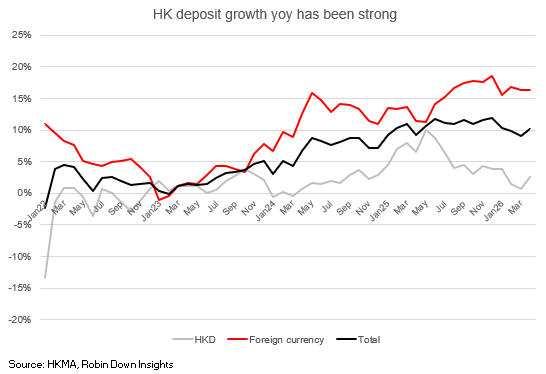
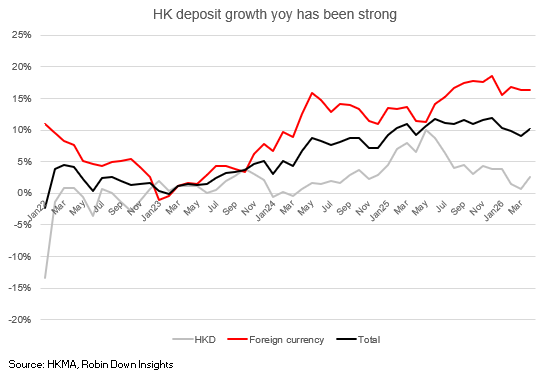
HK remains a deposit-led banking market (see my HK banking primer). Overall growth remains strong (+10.1% yoy), led by foreign currency denominated deposits (+16.3% yoy) with HKD-accounts growing at just 2.6%. April was a better month for the banks after a slightly soft February and March, so that’s encouraging. There’s lots of moving parts here; slightly higher Time deposit rates may have helped plus stock market activity. But there is a small, Dumbo-sized, elephant in the room - with the authorities recently clamping down on capital flows from the mainland - it will be interesting to see whether this softens deposit inflows near-term (and likewise what impact this might have on investment flows).
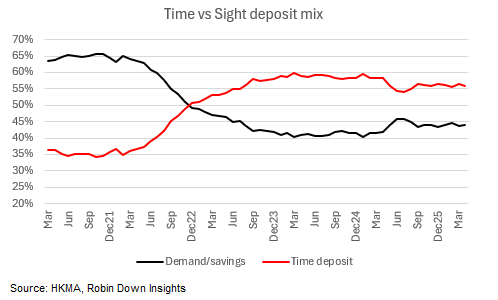
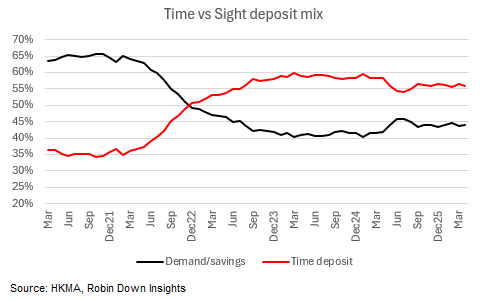
The mix of Time-deposits and Sight deposits remains broadly stable. I think its fair to say we’ve reached a genuine equilibrium point for the mix of deposits - April ended at 56.0% Time deposits (which are low margin) vs 44.0% for Sight deposits (high margin). A position which has been largely unchanged now for much of the last 12 months. This is a bit ‘glass half-full/glass half empty’ for the HK banks. On the one hand it removes one source of margin pressure (seen in 2022-23). But on the other hand my sense is that the banks had been hoping, in their margin forecasts, that we might have seen some switch back towards demand deposits this year as HIBOR rates fell. Note: I feel this was always a slightly optimistic assumption by HSBC and Standard Chartered - the only point in history where we’ve seen Time deposit shares fall meaningfully were when interest rates hit zero. Or put another way, there’s no point in history where Time deposit shares have fallen with non-zero rates.
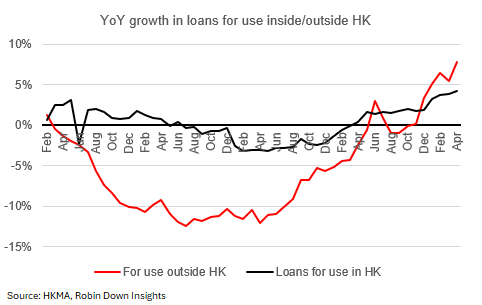
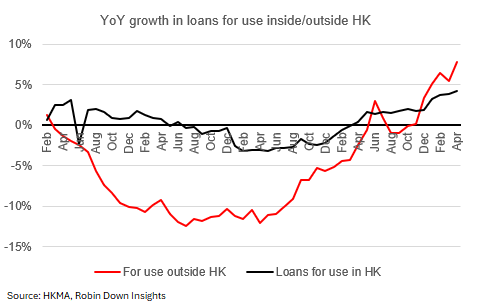
Lending continues to pick-up, albeit from a low base. Overall loan growth has risen to 5.2% yoy in April 2026 from 2.3% in December 2025. It remains to be seen what impact the US-Iran war has. But in the meantime the growth looks broadly based - loans for use in HK are +4.2% (vs +1.9% in Dec 25), loans for use outside HK are +7.9% (3.4% in December 25). We don’t get monthly sectoral data, but in the first quarter growth for HK-loans came from transport, manufacturing, investment companies and mortgages. Lending to CRE declined. Specifically for the mortgage market we continue to see improvements with balances growing at 3.1% yoy and rolling 3m approvals +50.1% in April 26 signalling some strength to come in future months.
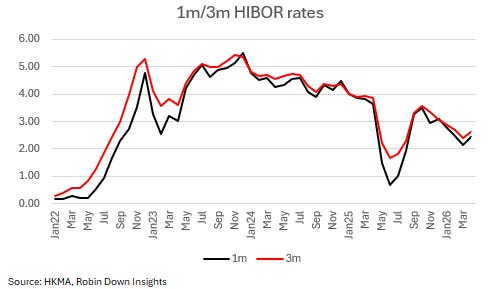
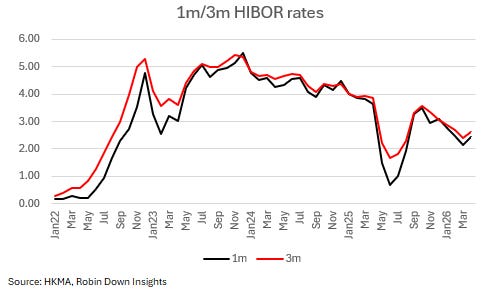
Deposit pricing looks to have drifted a little higher in May 2026. For example Standard Chartered is offering 2.3% on a new 3m Time deposit, up 20bp from April. I’d assume this is linked to some slight strength in Hibor rates, with the 3m average rate in May 2026 at 2.81% (vs 2.50% in April). Note Sight deposit rates are now just 0.01% - an effective floor (and realistically also a near term ceiling) which could slightly heighten the HK banks sensitivity to HIBOR rate moves near term….
…as discussed Hibor rates have trended higher in recent months. For May average 1m and 3m HIBOR stood at 2.60% and 2.81% up 44bp and 40bp respectively from their lows in March. As discussed in tmy HK Banking Primer, HIBOR rates can be volatile (depending on IPOs, corporate dividends etc). But assuming no dramatic changes, we look to be broadly on-track for 26Q2 average HIBOR rates to be close to 26Q1 levels. Suggesting a broader margin stability for the banks
Turnover in the HK Stock exchange remains strong. May-26 average daily turnover was up 39% on May-25 while 26Q2 to-date is up 13% yoy. But net flows in the Southbound stock connect have softened material. Year-to-date we’re at just USD44.5bn vs USD83.5bn at the same stage in the prior year. Again, readers should keep an eye here to see what impact the new restrictions on capital flows from mainland China into HK has
UK equivalent data will be in a separate post
Kindest regards
Robin